AI Automation for Plumbing Companies: How to Capture Emergency Calls, Win More Quotes, and Stop Losing Recurring Revenue
Plumbing companies lose 30-50% of emergency calls to slow response and 20-40% of quotes to no follow-up. AI automation fixes both without adding headcount.

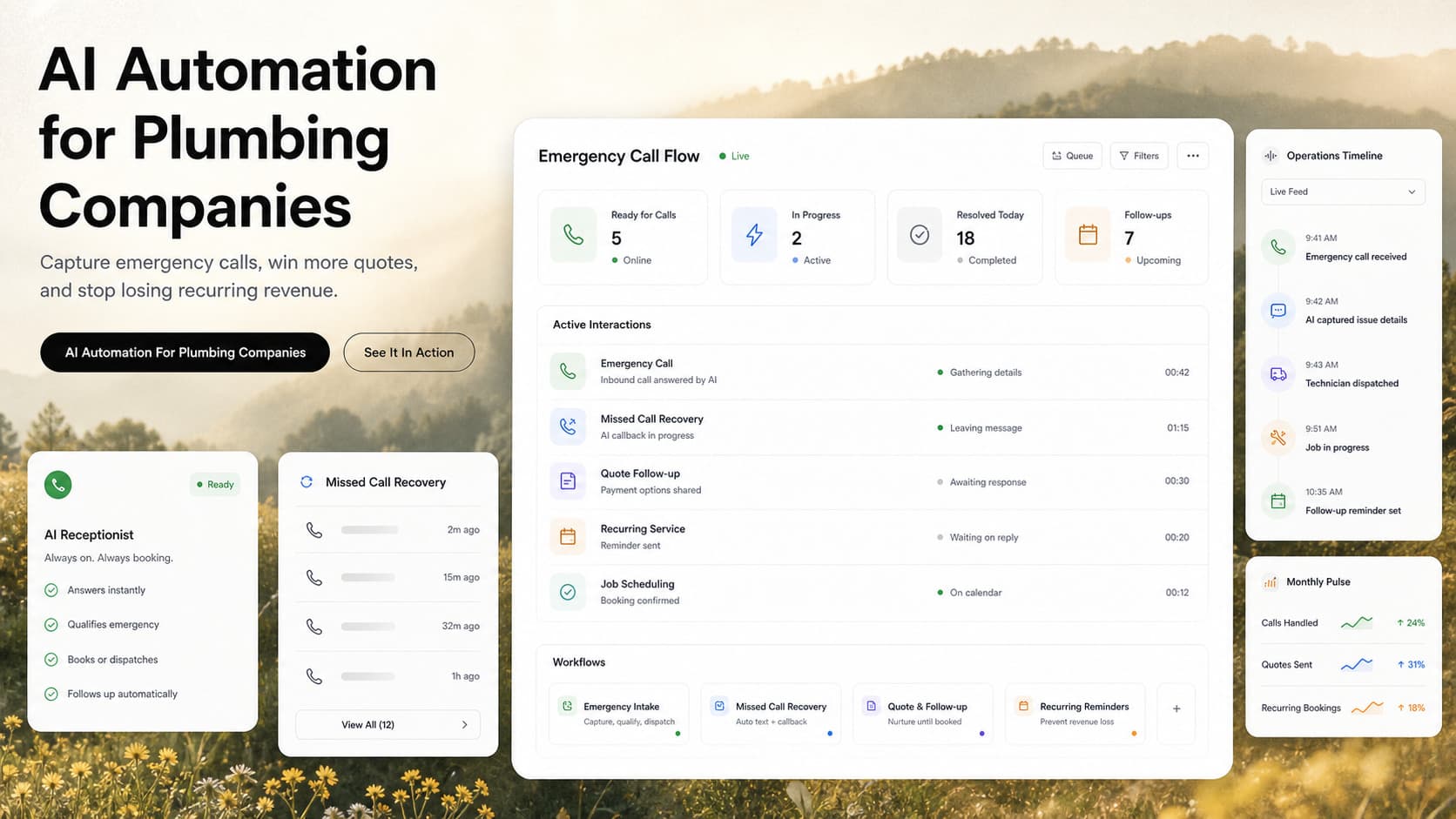
Quick answer: AI automation for plumbing companies uses AI voice agents, automated quote follow-up, recurring service cadences, and dispatch routing to capture every emergency call, close more bids, and keep maintenance agreements from lapsing, all without adding office headcount. The plumbing shops pulling ahead in 2026 are the ones that stopped treating the after-hours phone, the unsigned estimate, and the 11-month water heater as separate problems. They treat them as one workflow problem and let software handle the predictable parts.
If you run a plumbing company, you already know the three places revenue leaks before it ever lands on a P&L. You just see them as separate headaches:
- The phone that rings at 9:47 PM with a slab leak in Marietta, and you don't hear the voicemail until morning. By then the homeowner has called someone else.
- The $4,800 repipe estimate you emailed on Tuesday and never followed up on. The customer is still thinking about it. So are your two competitors.
- The 2018 water heater you replaced for the Hendersons that is now 11 years old, right at the failure curve, and your CRM never reminded anyone to reach out.
These are not people problems. They are workflow problems. And they are exactly what AI automation is built to fix.
Why Plumbing Companies Bleed Revenue They Cannot See
The residential plumbing industry has three structural patterns that hurt operators regardless of how good the plumbers are. None of them show up in the field. All of them show up in the office.
Pattern 1: Emergency Demand Is Inelastic and Asynchronous
When a pipe bursts at 11 PM, the homeowner is not comparison shopping. They are calling every name that comes up in Google, in order, until someone answers. The first shop to respond wins 60 to 80 percent of those jobs in our experience working with plumbers across the Southeast. Response time is the entire game, and most shops are losing it because their phones go to voicemail after hours and their morning is already booked before they can call back.
The numbers are consistent. Industry surveys put the average after-hours response time for small plumbing companies between 4 and 9 hours. During business hours, the first call still goes to voicemail roughly 30 to 40 percent of the time when a tech is on a job. Every one of those missed calls is a job that ended up somewhere else.
Pattern 2: Quote-to-Bind Is Slow and Forgotten
Residential plumbing estimates are emotional purchases. A homeowner with a $6,000 quote for a sewer line replacement is going to think about it, talk to their spouse, check their savings, and call two competitors. The shop that follows up at 24 hours, 72 hours, and 7 days with the right context wins a meaningfully higher share of those quotes than the shop that sent one email and waited.
Plumbing companies that track quote-to-bind report average close rates between 25 and 45 percent. Companies that do not track at all assume it is closer to 60 or 70 percent. The shops we have worked with who introduce an automated quote follow-up sequence typically lift close rates by 10 to 20 percentage points inside 90 days, which is often the difference between a profitable quarter and a flat one.
Pattern 3: Recurring Service Is a Gold Mine Most Shops Never Touch
A residential water heater has a service life of 8 to 12 years. A tankless unit runs 15 to 20. Sewer lines from the 1990s are due for camera inspection. Every job you completed in 2018 is a future job in 2026 if you tracked it. Most plumbing CRMs do not have a built-in replacement-cycle reminder, and even when they do, nobody has time to run it manually every month.
The shops winning at recurring revenue treat the install as the beginning of a 10-year relationship. They send a one-year check-in, a 6-year anode rod reminder, a 9-year replacement conversation, and a 12-year replacement close. That sequence is purely a function of the install date being in a structured system. Without automation, it does not happen. With automation, it pays for itself many times over.
What AI Automation in a Plumbing Company Actually Does
A working plumbing automation stack is not one product. It is a set of connected workflows that watch every signal your office and field produce and respond faster than a dispatcher could.
| Workflow | What it watches | What it does automatically |
|---|---|---|
| Emergency intake | Phone calls, web forms, Google LSA, chat, partner referrals | AI voice agent answers 24/7, qualifies the emergency, books the visit, and pages the on-call tech |
| Quote follow-up | Estimates sent, not signed | Sends a 24-hour text, 72-hour email, 7-day phone reminder, and 30-day re-engage for the lost quote |
| Dispatch and routing | Job location, tech skills, truck stock, traffic | Assigns the closest qualified tech with the right parts, sends the customer an arrival window |
| Recurring service | Install dates, equipment age, service history | Triggers one-year check-ins, mid-life maintenance reminders, and end-of-life replacement offers |
| Review generation | Completed jobs, payment received | Sends a one-tap review request routed to Google, then a follow-up for any rating under 5 stars |
| Technician enablement | Job notes, photos, manuals, code lookup | Puts the install manual, the local code book, and the prior service history on the tech's phone |
When this is wired together, a burst pipe at 11:14 PM becomes a booked 7 AM emergency visit by 11:15 PM, with the right tech, the right parts, and a confirmation text in the customer's pocket. A $6,200 repipe estimate goes out at 4:00 PM, gets a follow-up text at 4:00 PM the next day, an email with financing options at 4:00 PM three days later, and a phone reminder at the one-week mark. None of those touches required the owner to remember.
The Seven Workflows Plumbing Companies Should Automate First
Most plumbing owners know what is breaking. The question is which fix has the highest payback. Below is the order we use when we deploy into a new plumbing operation, ranked by revenue impact and time to value.
1. After-Hours and Overflow Call Handling
The single most expensive workflow in most plumbing companies is the one nobody touches: the phone that rings when the office is closed. Missed call text back services exist for a reason. AI voice agents go further.
The fix: Every inbound call routes to an AI voice agent that can recognize an emergency from a quote request, pull the customer's address from the CRM, check the on-call tech's availability, and book the visit. The agent pages the on-call tech with the job details and sends the customer a confirmation text. If the caller wants a quote instead of a service call, the agent collects the details, schedules a tech visit for an estimate, and creates the lead in the CRM.
The payoff: Plumbing companies that add 24/7 AI call handling recover 20 to 40 percent of calls that previously went to voicemail. For a shop doing $1.8M a year with 30 percent of calls after hours or missed during the day, that is often $80,000 to $150,000 in recovered annual revenue, with no additional office staff.
2. Quote Follow-Up and Win-Back
This is the highest-leverage workflow in any plumbing operation. The estimate already exists. The lead is already warm. The only thing missing is consistent follow-up.
The fix: When a tech marks an estimate as "sent" in the CRM, an automated sequence starts. The customer gets a personalized text 24 hours later ("Hi Mrs. Patterson, this is Marco's Plumbing following up on your repipe estimate. Any questions I can answer?"). If they open the email but do not sign, they get a second touch with a one-click review link. If they do nothing for seven days, the system alerts the salesperson to call. If they go silent for 30 days, the lead drops into a 90-day win-back cadence.
The payoff: Close rates typically lift 10 to 20 percentage points inside the first quarter. For a shop writing 80 estimates a month at an average ticket of $3,800, that is 8 to 16 additional jobs per month, or roughly $30,000 to $60,000 in added monthly revenue at the same lead cost.
3. Dispatch and Routing
Manual dispatch is the bottleneck that determines how many jobs your techs run per day. Most dispatchers work from memory, a whiteboard, and a stack of papers. Even good dispatchers leave 30 to 60 minutes per day on the table through suboptimal routing.
The fix: When a job is booked, the system checks tech location, current job status, skill set, truck inventory, and traffic. It assigns the right tech, builds the day's route, and sends an arrival window to the customer. If a job runs long, the system re-optimizes the rest of the day automatically. If a tech calls in sick, the system reroutes the day's jobs in seconds.
The payoff: Most shops see one additional job per tech per week once routing is automated, which is roughly a 10 to 15 percent lift in revenue without adding trucks or techs.
4. Recurring Service and Replacement Reminders
The cheapest job to book is the next one to an existing customer. The data already says which water heater is 11 years old, which customer has not had a sewer line camera inspection in a decade, which home is overdue for an annual backflow test.
The fix: Every install gets tagged with equipment type, install date, expected service life, and recommended maintenance intervals. The system triggers outreach at the right points: a 6-month check-in after a major install, a 1-year maintenance reminder, a 9-year replacement conversation for water heaters, a 15-year replacement conversation for tankless units. The message goes to the right customer through their preferred channel, with a one-click booking link.
The payoff: Plumbing companies with consistent replacement-cycle outreach book 20 to 40 percent more replacement jobs than shops that wait for the customer to call. A shop doing $2M with 30 percent of revenue from replacement work can add $120,000 to $240,000 in annual revenue from this workflow alone.
5. Review Request Automation
For local service businesses, Google reviews are the highest-ROI marketing channel in 2026. A shop with 400 reviews outranks a shop with 80 reviews in the map pack for almost every relevant search, and the click-through rate from the map pack is roughly 5x the click-through rate from organic results.
The fix: After the job is marked complete and payment is received, the customer gets a one-tap review request routed to Google. If the customer rates the job 4 stars or below, the message routes to the owner for a personal follow-up instead of going public. The whole sequence is logged in the CRM.
The payoff: Plumbing companies with a consistent automated review request typically add 30 to 50 new Google reviews per month. Over 12 months, that lifts map pack rankings on the most valuable local searches, which feeds back into lead volume.
6. Tech Enablement in the Field
The average residential plumbing tech spends 20 to 40 minutes per day on avoidable friction: looking up manuals, calling the office for a part number, waiting for a code clarification, hand-writing notes that get transcribed later. None of that adds billable hours.
The fix: Every tech carries a mobile app connected to the CRM. The app shows the job, the prior service history, the equipment manuals, the local code book, and the parts list for the truck. The tech can dictate a job note on the way to the next job. The note goes into the CRM, gets summarized, and shows up on the customer's record before the tech pulls out of the driveway.
The payoff: Most shops recover 30 to 60 minutes per tech per day, which translates to one additional job per tech per week once you account for drive time and average ticket size.
7. Office Workflow and Reporting
Owners of plumbing companies spend more time than they should pulling data from the field. How many open estimates? What is the close rate by tech? Which neighborhoods produce the most service agreement renewals? Where are we losing margin?
The fix: The CRM, dispatch board, accounting system, and review platform all feed a single dashboard that the owner can read in 60 seconds. The numbers are real because the data is captured at the source by automation, not typed in at the end of the week.
The payoff: Owners reclaim 4 to 8 hours per week and start making decisions based on actual margin, not gut feel. That time alone is often worth the entire automation investment.
What AI Automation Costs a Plumbing Company
Plumbing automation is not an enterprise line item. Most of the stack is monthly software that costs less than one part-time office employee.
- AI voice agent for after-hours calls: roughly $200 to $500 per month depending on call volume, plus a small per-minute usage fee
- CRM with built-in automation triggers: $80 to $300 per user per month
- Dispatch and routing software: $40 to $150 per tech per month
- Review request automation: $30 to $100 per month
- Recurring service and replacement cadences: usually bundled with the CRM
- Tech enablement mobile app: usually bundled with the field service platform
- Integration setup and ongoing optimization: typically a one-time project fee plus optional monthly managed service
For a plumbing company doing $1.5M to $3M a year with 4 to 10 techs, the all-in monthly cost for a complete automation stack is usually between $800 and $2,500 per month, plus a one-time setup that ranges from $3,000 to $15,000 depending on how much custom integration is required.
The payback is consistent: most shops recover the monthly cost inside the first month from quote follow-up alone, and they double or triple the monthly return once the emergency call handling and recurring service cadences are running.
How to Roll Out Plumbing Automation Without Blowing Up the Office
The mistake most plumbing owners make is trying to deploy everything at once. The shops that win treat automation as a phased rollout and let the team get comfortable before adding the next layer.
Phase 1, weeks 1 to 2: After-hours AI voice agent, automated quote follow-up, automated review requests. These three touch every customer interaction and start producing measurable lift immediately. No change to office workflow beyond responding to the leads that come in.
Phase 2, weeks 3 to 6: Dispatch routing, recurring service cadences, tech mobile enablement. These change how the office and field work together. They require a short training cycle and a willingness to retire the whiteboard.
Phase 3, weeks 7 to 12: Margin reporting, customer health scoring, win-back sequences for old estimates, equipment replacement offers for past installs. These are the workflows that take a plumbing company from running busy to running profitable.
Phase 4, months 4 and beyond: Cross-sell automation (water heater + water softener + filtration), service agreement renewals at the right cadence, referral sequences for happy customers, predictive maintenance flags from runtime data on tankless units and pressure regulators.
By the end of phase 2, the office should be smaller, the techs should be more productive, and the owner should be looking at a real dashboard instead of a stack of paper. That is when the compounding starts.
What to Watch Out For
Plumbing automation has three failure modes that are easy to avoid if you know they exist.
Failure mode 1: Picking tools that do not integrate. A CRM that does not talk to the dispatch board, a dispatch board that does not talk to the accounting system, a review platform that does not talk to the CRM. Most plumbing companies we work with already have one of these stacks. The fix is to pick the spine (usually the CRM plus the dispatch board) and ensure every other tool connects to it.
Failure mode 2: Automating before the workflow is clean. If the office is already inconsistent about logging estimates, automation will scale the inconsistency. The fix is to document the workflow first, then automate it. A 90-minute operations audit usually surfaces the bottlenecks that need fixing before any tool is deployed.
Failure mode 3: Forgetting the customer experience. Automation that texts customers at 6 AM, or that calls them three times in a row, or that sends a generic "Hi valued customer" message, will lose more jobs than it wins. The voice agent needs the shop's tone, the texts need the tech's first name, and the review request needs the customer's actual job. Personalization is the difference between automation that customers hate and automation that customers prefer to a phone call.
Where to Start
If you run a plumbing company and want to begin, the highest-leverage first move is to track quote-to-bind for 30 days. You cannot improve what you do not measure. Once you know your close rate, your no-show rate, your after-hours call volume, and your recurring service revenue, the automation plan writes itself.
From there, the typical first deployment is the AI voice agent plus the quote follow-up sequence. Both pay back in the first month, both touch every lead the shop generates, and both free up the office staff to focus on the customers who actually need a human.
Want a plumbing-specific automation plan? Contact us and we will walk through your call volume, your close rate, and your recurring service list, then map the three or four workflows that will pay back first. We work with plumbing shops in the Southeast and remotely across the US.
Related articles

AI Automation for Cleaning Companies: How to Win More Bids, Keep Crews Filled, and Stop Losing Recurring Contracts
Cleaning companies lose 30 to 50 percent of bids to slow follow-up and 15 to 25 percent of accounts to sloppy inspections. AI fixes both without adding staff.
Read the article: AI Automation for Cleaning Companies: How to Win More Bids, Keep Crews Filled, and Stop Losing Recurring Contracts
AI Office Manager Replacement for Service Businesses: When Automation Beats a $55K Hire
A full-time service business office manager costs $45K to $65K plus benefits. AI automation handles scheduling, dispatch, invoicing, and follow-up for under $400 a month. Here is when to hire and when to automate.
Read the article: AI Office Manager Replacement for Service Businesses: When Automation Beats a $55K Hire
AI Automation for Electrical Contractors: How to Capture Emergency Calls, Win More Bids, and Stop Losing Recurring Revenue
Electrical contractors lose 25-45% of emergency calls to slow response and 20-40% of bids to no follow-up. AI automation fixes both without adding headcount.
Read the article: AI Automation for Electrical Contractors: How to Capture Emergency Calls, Win More Bids, and Stop Losing Recurring Revenue
