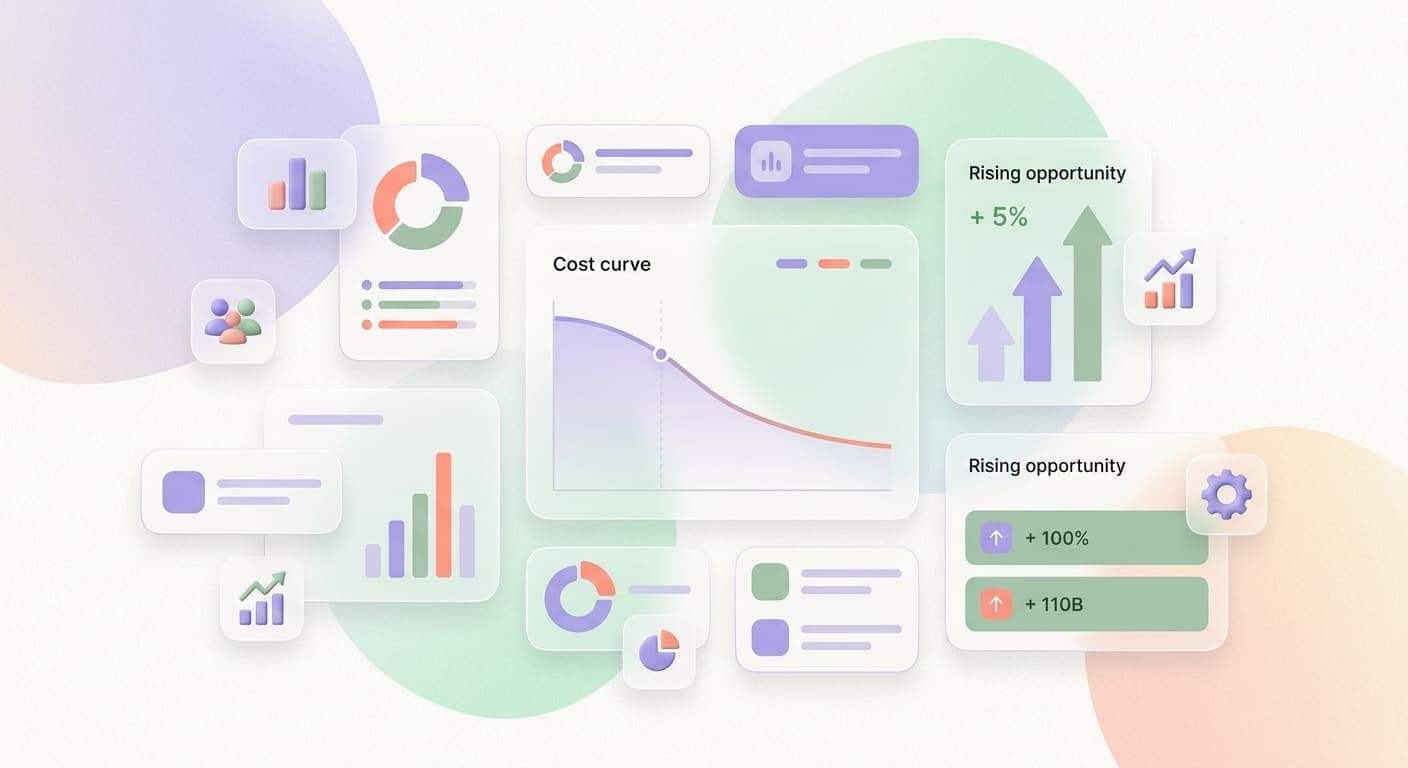
The Price of AI Just Keeps Falling
Six months ago, running a capable AI model in your business cost real money. Today, that same capability costs a fraction of what it did, and it's still dropping.
This isn't a trend. It's a structural shift. The cost of running AI inference has been cut repeatedly over the past 18 months, driven by hardware advances, model efficiency improvements, and intense competition between providers.
For large companies, this is nice. For small and mid-size business owners, this is a window, and it's open right now.
What's Actually Getting Cheaper
To be clear about what we mean: the cost to run AI tasks, analyzing a document, drafting a reply, routing a support ticket, extracting data from a form, has dropped significantly.
A year ago, automating customer support responses with a quality AI model could cost you several dollars per thousand interactions. Today you can run the same quality of work for a fraction of that, using models that are also faster and more reliable.
That changes the math on a lot of business processes you may have written off before.
Where This Opens Doors for Smaller Businesses
The reason big companies adopted AI first wasn't that they needed it more. It was that they could absorb the cost.
Now that's less true. Here are the use cases that are actually worth looking at:
Lead follow-up. An AI that reads incoming inquiry emails, qualifies them based on your criteria, and sends a personalized first response in under five minutes. This used to cost too much to justify for lower-volume businesses. The math is different now.
Document processing. Invoices, contracts, intake forms, pulling structured data from unstructured documents is exactly what modern AI does well and what humans find tedious. With current model costs, automating this for even a 10-person operation makes sense.
Internal Q&A. Building a knowledge base that your team can actually query, instead of hunting through shared drives, is no longer a six-figure IT project. It's a week of setup work with off-the-shelf tools.
Customer support triage. Not replacing your support team, but making sure every ticket gets read, categorized, and routed immediately, even at 2am on a Saturday.
The Catch (There's Always One)
Cheap compute doesn't mean cheap implementation. The models are more affordable. But getting them to work reliably inside your specific business context, connected to your CRM, your inbox, your data, still requires real setup work.
This is where a lot of business owners get burned. They plug in a general-purpose tool, it works 70% of the time, and then they spend more time managing the failures than they saved in the first place.
The gains come from building something that fits your actual workflow. Not from subscribing to another SaaS dashboard that sounds impressive in a demo.
What to Do With This Information
If you've looked at AI automation before and decided the ROI wasn't there, it's worth revisiting that decision. Not because AI is magic now, it isn't, but because the cost side of the equation has genuinely changed.
Start with one process. The one that costs you the most in manual time, or the one that creates the most friction for your customers. Get that working well before adding more.
The businesses that will pull ahead over the next two years aren't the ones that adopt the most AI tools. They're the ones that get a small number of AI processes working cleanly and reliably, and then build from there.
Want to figure out where automation would actually make sense for your business? Talk to us, we'll tell you straight what's worth building and what isn't.